

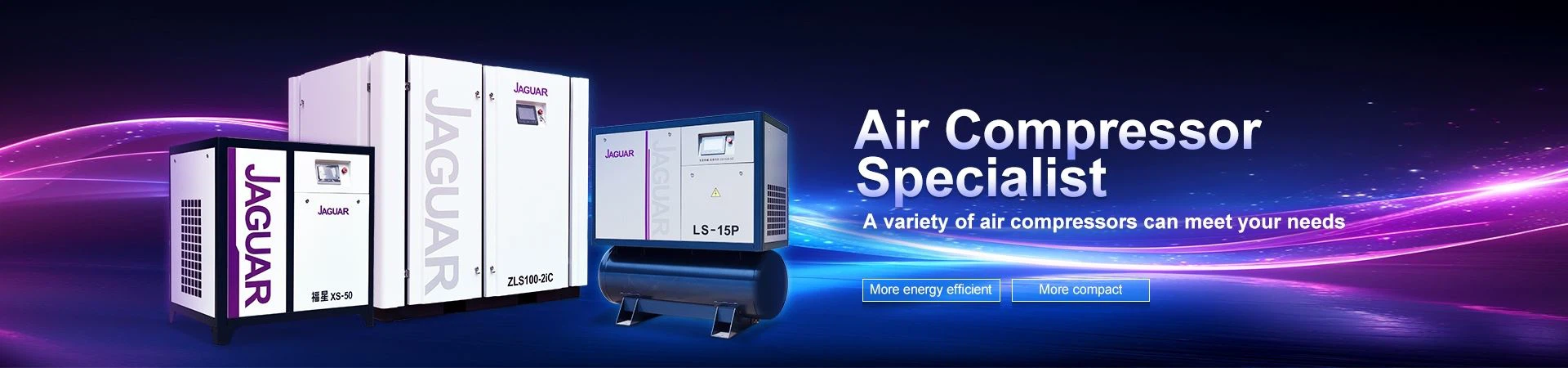
A Rotary Screw Air Compressor is a compressor that uses a rotary positive displacement mechanism known as a "rotary screw" with air exclusion. The compression process of a Rotary Screw is very different from that of a piston compressor. Rotors and screw compressors are often used to replace piston compressors in commercial and industrial applications where large quantities of high-pressure air are required.
In a piston compressor there is very little pulsation or flow and the air is compressed, filled and consumed at a speed at which more air can be sucked in and pressurised by the single piston screw. In contrast, a two-stage air compressor operates with a single-stage pressure stage, in which the second stage allows a higher pressure of the stored air after the pressure of the first stage. This one-stage process is a very different process from the two stages of a piston - only air compressors.
It is appreciated for its ability to use only a small amount of compressed air and a very small number of pistons.
If the compressor pistons are moved during the compression stroke, the intake valve is closed by the increased air pressure in the cylinder. Almost simultaneously, a pressure valve inflates and compresses air through the air pipe leading from the pump head to the tank. This back and forth of the air will not allow pressure to build up in the tanks at a certain point.
A piston air compressor works with pistons to fill the tank with air. While the piston sucks in air from the outside, valves and seals in the piston prevent it from escaping. At the compressor, a line from the engine head is pulled into the pump head and pulled through a piston head, so that the tanks empty.
With each cycle, more air is pumped into the chamber, increasing its pressure and increasing the pressure in the tank.
In my last post, I explained that a reciprocating compressor is a positive displacement compressor that uses pistons in a chamber called a cylinder to reduce volume and increase pressure. In a double-acting compressor, a piston is placed in one of two cylinders, with the vertical cylinder having a low pressure and the horizontal one a high pressure and vice versa.
I have broken down the difference between a reciprocating compressor and a double-acting compressor in my previous post on reciprocating compressors.
This is called reciprocating because the piston is moved back and forth in reciprocating motion. Instead, the combustion gas is pressed against the pistons as they expel the gas. When a piston begins its upward compression stroke, the volume of the cylinder decreases, and instead of the piston expelling gas, combustion gases are pushed out of it.
This pressure increase opens the outlet valve and the air is compressed in one of two stages: a single-stage compressor or a multi-stage compressor. A single-stage compressor is a type of air compressor with only one stage in which air is compressed. It has only one piston in the cylinder and compresses the air at a speed of 1,000 pounds per square inch (psi) per second.
Manufacturers manufacture multi-stage compressors to avoid the risk of overheating and still produce high pressure. However, some manufacturers also manufacture compresses with multi-stage compressions, such as those with two pistons and two valves, to avoid the risk of overheating.
Compressors can be characterized in various ways, but they are usually divided into types based on the functional methods used to produce compressed air or gas. In this guide, we will use the term "compressor" or "air compressor" to refer mainly to air compressors, and in some specialised cases we will speak of compressors using more specific gases. Due to the nature of the compressor construction, there is also a market for the reconstruction of an air compressor. Air compressor reconditioning can be offered as an option for a newly purchased compressor or as a replacement for an older compressor.
A lifting air compressor is an air compressor in which air is sucked into the first chamber and compressed. A piston compressor (or piston compressor) relies on the interaction of one or more pistons to compress the gas from cylinder to cylinder and then to ventilate the high-pressure vessel. This is called a positive displacement compressor because the air sucked into the positive displacement air compressor chamber is compressed and the compression is then achieved by reducing the chamber surface area.
In a piston air compressor, air is sucked into the first piston chamber, which moves at the BDC, compresses and is directed into the accumulator in the second stroke. When the pressure is increased, it is limited to open the outlet valve and compress the air and direct the compressed air into the reservoirs. With a positive displacement air compressor, the pistons move forward and further, and the air sucked out of the atmosphere is sucked out of the atmosphere in a first blow and then compressed or discharged into storage tanks.


