

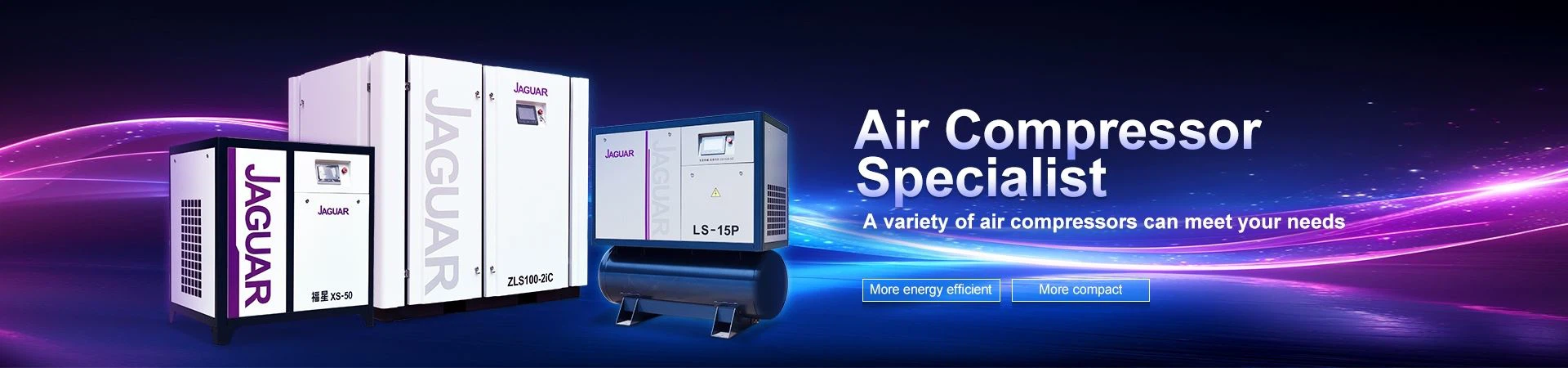


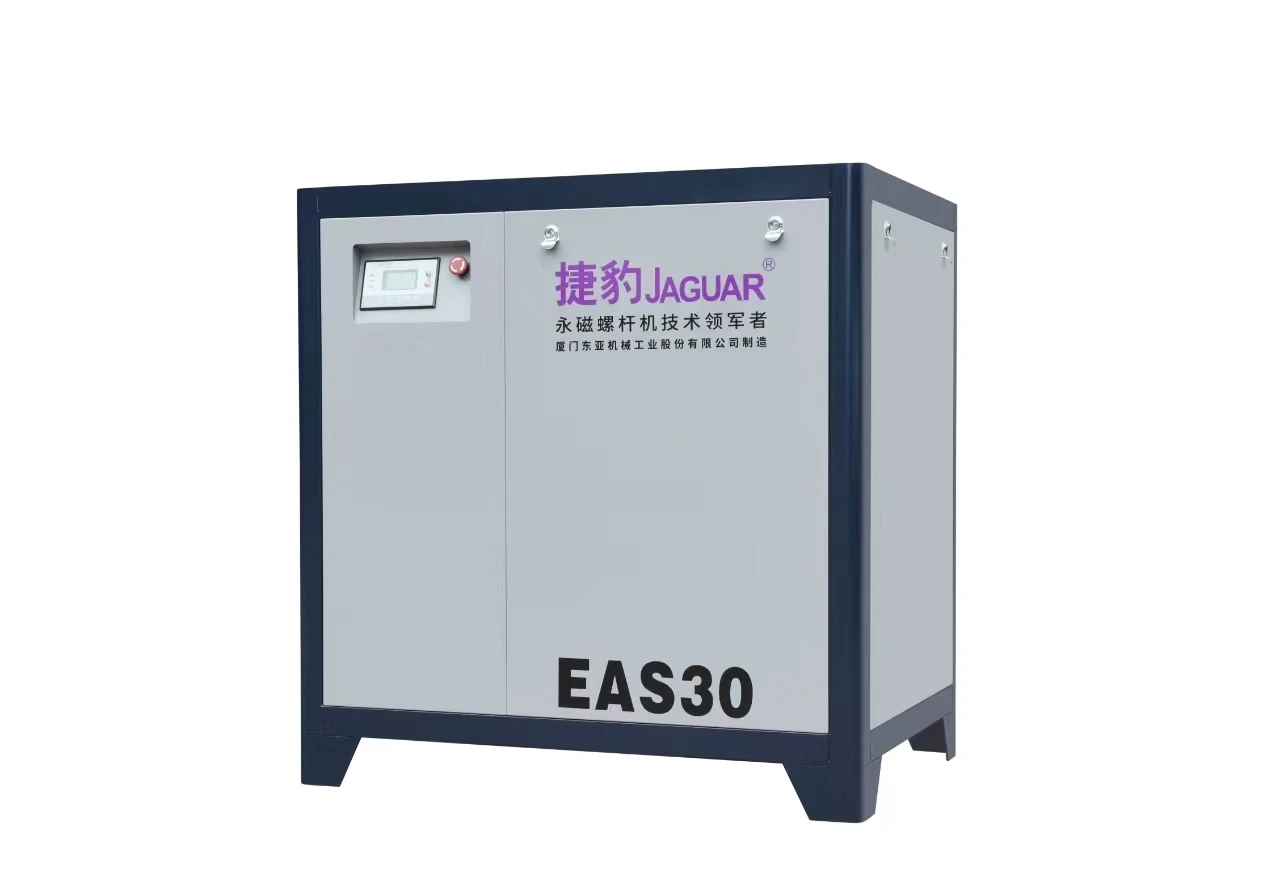
Belt Drive Screw Air Compressors EAS
EAS Belt-driven Air Compressor
Jaguar EAS series are economical belt-driven screw air compressors with power ranging from 7.5kW to 55kW. Equipped with screw airends, they deliver large air displacement and stable transmission. Fitted with German imported belts for outstanding durability. The compact unit structure allows air pressure adjustment by simply replacing pulleys, cutting maintenance costs significantly. Featuring high-efficiency asynchronous motors and imported filter consumables, the compressors excel in heat dissipation and noise reduction, ideal for small and medium-sized factories in machinery, textile, photovoltaic, automotive and other industries.


What are Advantages of Belt Drive Screw Air Compressors
Economy
The belt drive is a simple and afordable solution. Maintenance is simple, with oil and fiter changes needed every 500 to 1,000 hours of regularuse
Durability
The belt drive has excelent shock absorption and vbration dampening. It can also protect your air compressor from experiencing an overioadwhen the belt slips over a pulley.
Quieter
Belt-driven models, which are quieter, are generally better for environments in which noise emissions have to be kept low, e.. in indoorenvironments or residential neighborhoods.
What type of Belt Drive Screw Air Compressors
01.Open Belt Drive
In an open belt drive, both pulleys rotate in the same direction. With a horizontal pulley arrangement, the tight side of the belt is at the bottom and the slack side is at the top to increase the belt's angle of contact with the pulleys.
02.Cross Belt Drive
03.Stepped Cone Pulley
04.Fast and Loose Cone Pulley
05.Jockey Pulley Drive
06.Quarter Turn Belt Drive
Most belt drives can only work with parallel shafts. But this may not always be the case. In situations where rotating shafts are at the right angles, we can use quarter turn belt drives.Quarter turn belt drives (aka right angle belt drives) have a belt that goes around two perpendicular shafts after making a quarter turn. For the belt to stay in place, the pulley's width must be at least 40% wider than the belt's cross-section.In some cases, guides or idler pulleys are used to promote better belt tracking and prevent slip off.
07.Compound belt drive
Equipment and Workspace Setup Safety Tips
The way your equipment and workspace are set up can have a significant impact on safety. Some air compressor and workspace setup tips to keep in mind include:
Component Pressure Ratings:
Make sure that all components, including hoses, pipes and fittings, are rated for the maximum pressure of the air compressor.
Relief Valves:
Relief valves automatically release air if the pressure in the tank gets too high. These valves are important air compressor tank safety features, so you should never attempt to adjust, bypass or remove them.
Drain Valves:
If your compressor has an electric drain valve, make sure it is at least a foot and a half above the ground. Electric drain valves must be kept away from moisture.
Shutoff valve: The shutoff valve should always be visible and within reach when working with compressed air.
Guards for Moving Parts:
Ensure that all moving parts, such as flywheels, belts and pulleys, are effectively guarded.
Workspace Air Circulation:
Intake air contains pollutants and carbon monoxide that can be hazardous to your health. For these reasons and others, it's essential to keep your workspace circulated with clean air at all times.
Workspace Humidity:
It's important to keep the humidity in your workspace from getting too high. To decrease the moisture in the air, try increasing air circulation in the workspace, operating your compressor for longer periods, using a peripheral crankcase heater or adding a dryer to your compressed air system.
Tip 1: Remove Belt Guard
The belt guard is for safety and it is important that the belt guard is always functional so that the compressor is safely fastened. It is kept in place by screws and snaps, so carefully remove the belt guard by twisting and separating pressure snaps.Store the screws safely, so that it can be reattached once the cleaning is done.
Tip 2: Inspect Belt
You are supposed to visually check for any breaks or fraying for the belt. If you see any signs of breakage or fraying, take immediate action.If the belt is damaged, replace it and if not, move to step 4.
Tip 3: Remove & Replace Belt
Loosen the four bolts and hold the motor in place and then shift the motor towards the pump. It should be loose enough so that it can be easily removed.Now move the motor back to its position so that proper belt tension is created and then tighten the motor bolts. Finally, replace the belts.
Tip 4: Align the Belt
Start by laying the straightedge against flywheel touching and adjust the motor pulley so that the belt is parallel to the straightedge.Now use a gear puller so that the pulley is on the motor shaft, tightening the setscrew after positioning the pulley.Adjust the motor distance by adjusting motor position. Repeat if needed by testing tension.
Tip 5: Reattach the Belt Guard
Place the belt guard back on the unit. Either snap pressure will snap back or replace the screws and tighten.Please note that air compressors produce tons of vibration which can result in the screws loosening up.These are some of the easy steps to ensure that your belt guard is operational at all times. Since the belt is covered, there is a high chance that you will miss out on the maintenance part.
Frequently Asked Questions
Q: What is the core working principle of belt-driven air compressors?
Q: What advantages does belt transmission bring to air compressors?
Q: How to adjust the tightness of the compressor belt correctly?
Q: Why does the belt slip during long-time operation?
Q: What is the main difference between belt-type and direct-drive air compressors?